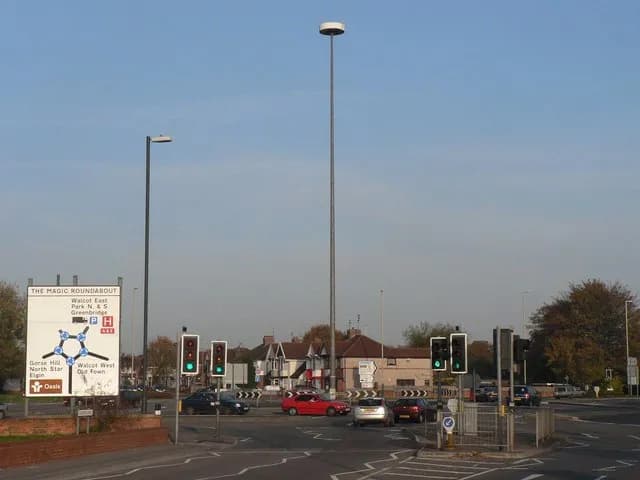
Built on the site of a notoriously congested junction, the structure now known as the Magic Roundabout was hailed as an engineering triumph when it opened in September 1972. Yet within decades, the junction had become a source of national fascination, repeatedly voted among Britain's most feared road crossings despite enjoying what transport experts describe as a relatively good safety record.
From Drove Roundabout to the County Islands Experiment
The site at the intersection of County Road (A4259), Fleming Way, Drove Road, and Shrivenham Road had long troubled Swindon motorists. The original Drove Roundabout suffered chronic congestion and a poor safety record, creating a bottleneck for traffic moving between the town centre and its western approaches.
The solution came from Frank Blackmore, a researcher at the British Transport and Road Research Laboratory (RRL). Blackmore had spent years developing the mini-roundabout concept, and the Swindon site provided the perfect test for his most ambitious design: a ring junction comprising five mini-roundabouts arranged in a circle around a central anti-clockwise roundabout.
The design was originally intended for Birmingham, but when the council there could not fund the project, Swindon Borough Council's Principal Traffic Engineer Ray Harper brought the scheme to Wiltshire. Work began on the County Islands Roundabout in 1972.
How the Junction Works
To the uninitiated, the Magic Roundabout appears chaotic. Traffic flows clockwise around the five outer mini-roundabouts, whilst vehicles in the central circle travel anti-clockwise. This counter-intuitive layout means drivers can choose their path: either following the outer circle conventionally, or cutting through the centre against the apparent flow.
The result is a junction with a capacity of 6,200 vehicles per hour, a significant improvement on the old roundabout's 5,100 vehicles per hour. Research conducted at the time showed that the design improved throughput by 25 to 35 per cent compared to signalised alternatives.
Early trials of the system used painted markings and old tyres to define the mini-roundabouts. A crane-mounted camera monitored traffic flow during the pilot phase, whilst police officers were stationed at each mini-roundabout to guide motorists.
The "Magic" Name Takes Hold
The roundabout's official name remained County Islands Roundabout throughout the 1970s. The now-famous moniker came from a BBC press officer attending the launch, who reportedly remarked that the swirling traffic resembled Zebedee from the BBC children's television series The Magic Roundabout.
Local councillor David Glaholm campaigned for the nickname to be made official in the early 1980s. "I'm just pleased that the name 'Magic Roundabout' has spread around the world, which means the name 'Swindon' has travelled around the world too," Glaholm told the BBC in a 2024 interview.
Fear and Loathing on the National Stage
Despite Swindonians' evident pride in their landmark, the junction has repeatedly featured in national surveys of Britain's most intimidating road features. In December 2007, a Highway Insurance Agency survey ranked it the seventh most feared road junction in the UK. Two years later, a Britannia Rescue survey of 3,225 drivers placed it fourth on the list of Britain's scariest junctions.
The Magic Roundabout has also gained international notoriety. In September 2007, the motoring magazine Auto Express named it one of the world's worst junctions. The distinction sits uneasily alongside the roundabout's technical success.
The Safety Paradox
Transport professionals point to a curious contradiction in the roundabout's reputation. Despite the fear it inspires, the junction has maintained a relatively good safety record throughout its 53-year history.
Roads.org.uk, which documents British road infrastructure, notes that "they also have an excellent safety record, probably because all traffic is moving too slowly to do any real damage in the event of a collision."
Julian Brunetti, who operated the Queens Drive Post Office overlooking the roundabout, told the BBC in 2012: "You get the odd accident now and again when people are a bit silly." A commenter on a BBC Wiltshire feature from 2005 noted simply: "Never been a serious accident on it ever."
Swindon's Icon
The Magic Roundabout has become Swindon's most recognisable landmark, eclipsing even the town's railway heritage. Kevin Beresford, chairman of the UK Roundabout Appreciation Society, told the BBC in 2012: "Swindonians should beam with pride with this fantastic feat of road engineering, which it has to be stated has now achieved iconic status around the world."
The society produces calendars and keyrings featuring the junction, and members organise trips to Swindon specifically to view it. The roundabout has inspired songs; the band XTC used the concept as inspiration for one of their tunes. It even features in travel guides, which advise tourists to stick to the outer circle whilst leaving the inner "pro driver path" to locals.
Local residents have embraced the junction's fame. One commenter on a 2005 BBC feature recalled meeting an American in Spain: "When I said Swindon, his first words to me were 'You mean the Magic Roundabout Town'."
A Design Frozen in Time
Unlike many transport infrastructure projects from the 1970s, the Magic Roundabout has survived largely unchanged. A similar junction at Bruce Street Bridges, which had four entry and exit points rather than five, was converted to a conventional roundabout in 2016. The original Magic Roundabout continues to operate in virtually the same configuration as when it opened.
The junction remains a fixture of Swindon life, a daily challenge for commuters and a point of pride for residents. For visitors approaching the town, those five swirling mini-roundabouts serve as both warning and welcome: you have arrived somewhere unmistakably Swindon.