In 1841, a decision made on a windswept hill in Wiltshire transformed a modest market town of 2,500 inhabitants into one of Britain's great industrial centres. That decision, approved by the Great Western Railway board on 25 February 1841, established Swindon as the site for the railway works that would define the town for nearly 150 years.
The Choice of Swindon
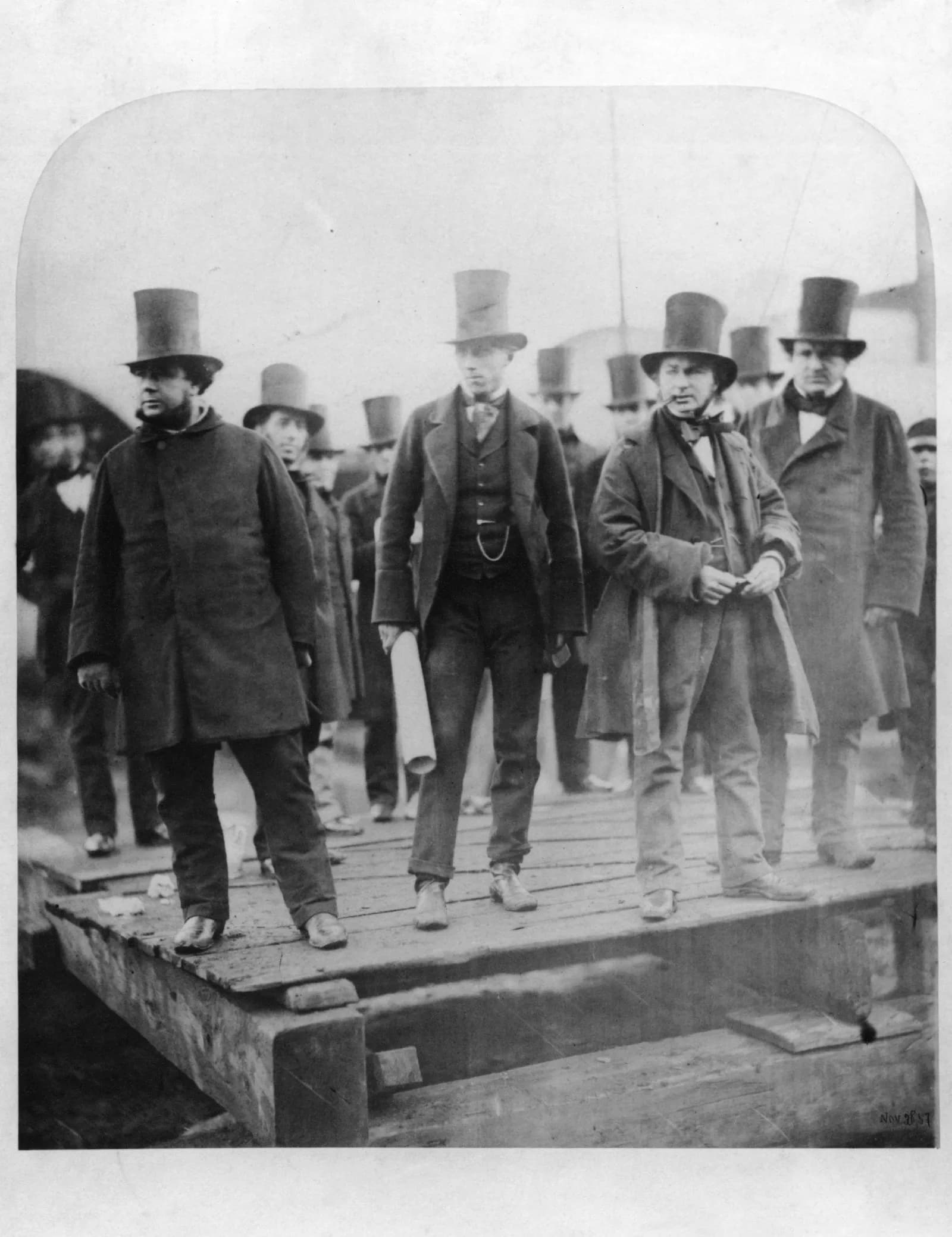
Isambard Kingdom Brunel, chief engineer of the Great Western Railway from 1833, needed a central repair and construction facility for his London to Bristol main line. Parliament had approved the route in 1835, but the location of the works remained unresolved until 1840.
Daniel Gooch, whom Brunel had recruited in 1837 as Superintendent of Locomotive Engines, identified Swindon as the ideal site. In his later writings, Gooch recorded: "I was called to report upon the best situation to build these works… Mr. Brunel and I went to look at the ground, then only green fields, and he agreed with me as to its being the best place."
The site's advantages were practical: it lay at the junction with the proposed Golden Valley line to Cheltenham, provided a convenient division point for changing engines, and the Wilts and Berks Canal offered direct connection to the Somerset Coalfield. The arduous gradients between Swindon and Bristol necessitated engine changes, making a works location essential.
Construction began immediately after the 1841 authorisation. The first repair shed was completed that year, machinery was installed in 1842, and the works became operational on 2 January 1843.
The Works That Made a Town
What began as a modest repair facility grew into an industrial giant. The workforce expanded from 200 men initially to over 2,000 by 1851. At its peak in the first half of the twentieth century, the works employed more than 14,500 people, with an estimated three-quarters of Swindon's working population depending upon the railway for their livelihood.
The first locomotive built at Swindon, "Premier" (later renamed "Great Western"), rolled out in 1846, constructed in under two weeks. This prototype of the Iron Duke Class was capable of speeds up to 70 miles per hour. By 1851, the works was producing approximately one locomotive per week.
The facility's growth was relentless. In 1867, Swindon became the central workshop for carriage and wagon construction. A separate carriage and wagon works was built in 1878. The conversion from Brunel's broad gauge to standard gauge, completed across the GWR network by 1892, required massive resources: over a single weekend in May 1892, Swindon stored 195 locomotives, 748 carriages, and 3,400 wagons awaiting conversion.
The A Shop, covering 11.25 acres, became one of the largest covered industrial spaces in the world. The works eventually sprawled across 320 acres, a testament to the scale of Victorian railway engineering.
A Model Community: The Railway Village
Brunel and Gooch understood that workers required housing. In 1841, they proposed building a village adjacent to the works. The Railway Village that emerged was constructed from stone quarried locally and from the excavation of Box Tunnel.
By 1853, 243 houses were complete; all 300 terraced cottages were finished by the mid-1860s. The streets were named after GWR destinations: Bristol Street, Bath Street, Taunton Street, London Street, Oxford Street, and Reading Street.
The village represented something unprecedented in British industrial history: a comprehensive welfare system decades before the welfare state. The Mechanics' Institute, founded in 1844 with its building completed in 1855, housed Britain's first lending library, established in 1843 with approximately 130 books. The institute provided education, lectures, theatrical performances, and ambulance classes.
The GWR Medical Fund Society, established in 1847 following Gooch's prompting, offered cradle-to-grave healthcare funded by workers' wage deductions. The GWR Hospital opened in 1871 following a £1,000 donation from Gooch himself. The Medical Fund Baths and Dispensary, built between 1891 and 1892, later became the NHS Health Centre and Health Hydro.
Nye Bevan, architect of the National Health Service, reportedly observed: "There was a complete health service in Swindon. All we had to do was expand it to the country."
From Two Towns to One
The impact upon Swindon was transformative. In 1841, the population stood at 2,495. By 1901, it had reached 45,006. The railway had created "New Swindon" adjacent to the works, physically and administratively separate from "Old Swindon" on the hill.
The two Swindons remained distinct municipalities until 1900, when Queen Victoria signed the charter amalgamating them on 22 January that year. The railway town had effectively swallowed its parent.
Decline and Reinvention
The works' dominance could not last indefinitely. The last steam locomotive, British Railways Standard Class 9F 92220 "Evening Star", was built in 1960. Locomotive construction ended in 1965, and the works closed permanently on 26 March 1986.
Yet the physical and cultural legacy endures. The Railway Village, saved from demolition in the 1960s by a campaign led by John Betjeman, is now a conservation area with Grade II listed buildings. The Mechanics' Institute holds Grade II* listing.
STEAM – Museum of the Great Western Railway, opened in 2000, occupies a former engineering workshop built circa 1842. The museum displays historic locomotives including a replica of "North Star" and the original "City of Truro", alongside "King George V".
The former works site has been redeveloped into the Swindon Designer Outlet, English Heritage headquarters, and the National Trust's Heelis building. The Brunel Shopping Centre and Brunel Way keep the engineer's name prominent in the town he transformed.
The Man Behind the Transformation
Brunel himself never lived to see Swindon's full flowering. He died in 1859, aged 53, having already secured his place among Britain's greatest engineers through his work on the Great Western Railway, the SS Great Britain, and the Clifton Suspension Bridge.
Yet his decision to back Gooch's recommendation for the Swindon site set in motion changes that would define the town for generations. The population figures tell the story: from 2,495 in 1841 to 224,942 in 2021. Swindon grew not despite its railway heritage, but because of it.
Today, visitors to the Railway Village, the STEAM Museum, or the preserved cottages of 34 Faringdon Road, restored as a living museum to circa 1900 conditions, can trace the outlines of the world Brunel and Gooch built. It was a world of steam, steel, and social innovation; a world that turned a Wiltshire market town into a railway metropolis.