Lydiard Park stands as one of Swindon's most treasured historic assets, a 260-acre estate that has witnessed more than seven centuries of English history. From its origins as a medieval deer park to its current role as a beloved public space, the estate encapsulates the evolution of the English country house and the democratisation of heritage in the twentieth century.
Domesday Origins and Medieval Foundations
The story of Lydiard Park begins in the Domesday Book of 1086, when the settlement of Lediar was held by Alfred of Marlborough. The estate comprised seven hides of land worth £6, a reduction from its pre-Conquest value of £10. The Tregoze family acquired the estate in 1198, and in 1259 King Henry III granted Robert Tregoze a royal licence to create a deer park in the surrounding woodland. Robert Tregoze died at the Battle of Evesham in 1265, but the estate remained in his family's possession for over two centuries.
The St John Family Inheritance
In 1420, the estate passed through marriage to the St John family, whose seat was at Battersea in London. This transfer marked the beginning of a 500-year association that would shape Lydiard's destiny. The St Johns rose to prominence in national affairs: Oliver St John was created Viscount Grandison in 1623 and served as Lord Deputy and Lord High Treasurer of Ireland; his nephew Sir Walter St John founded the Sir Walter St John School at Battersea; and Henry St John became Viscount Bolingbroke, a leading Tory statesman of the early eighteenth century.
The family was deeply committed to the royalist cause during the Civil War. Sir John St John, who died in 1648, worked tirelessly for King Charles I, and three of his sons died fighting for the crown. In recognition of their loyalty, John St John was made a baronet in 1611.
The Palladian Transformation
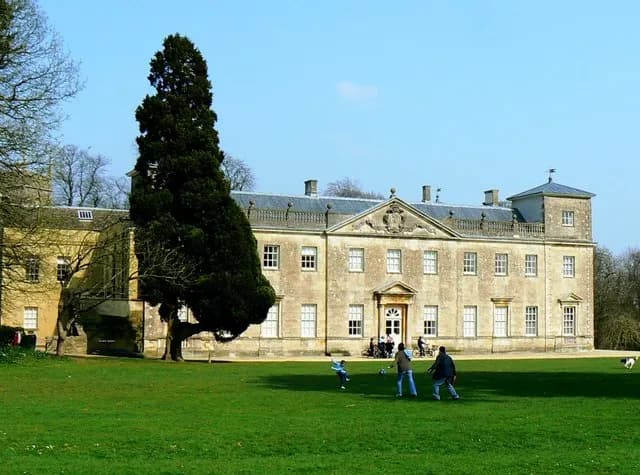
The Lydiard House that visitors see today owes its elegant appearance to the 1740s, when John, 2nd Viscount St John, and his wife Anne Furnese undertook a major redevelopment. Anne brought substantial wealth to the marriage, enabling the couple to transform the medieval and seventeenth-century structure into a Palladian mansion. An inscription in the attics records that the house was "rebuilt" by John, Viscount St John, who died in 1748.
The south and east fronts were reworked in the Palladian style, probably by the architect Roger Morris. The result is a house of two stories with eleven bays; the three central bays project slightly, whilst the end bays rise an additional story to form two towers with pyramidal roofs. A cartouche carved with the St John arms and the escutcheon of the Furnese family adorns the tympanum. The only significant addition since 1743 was a mid-nineteenth-century kitchen wing to the west, which was converted to sleeping accommodation in the 1960s.
War and Transition
The Second World War brought dramatic changes to Lydiard Park. In 1942, the estate served as a military hospital for American forces. Between 1943 and 1946, it became Prisoner of War camp No.160, housing German soldiers as a POW hospital.
The war also precipitated the end of private ownership. In 1943, Councillor and Alderman Francis Akers purchased the dilapidated estate at auction and immediately sold it to Swindon Corporation for £4,500. This transaction, championed by Town Clerk David Murray John, who served from 1939 to 1974, marked the beginning of Lydiard's life as a public asset. The park opened to the public all year round in 1955.
Restoration and Rediscovery
The transfer to public ownership set in motion decades of restoration and research. In 1955, furniture arrived on loan from the National Art Collections Fund as part of the E.E. Cook bequest. Lord Bolingbroke loaned several St John family portraits to the house in the 1960s, later selling them to the corporation, and bequeathed the house's contents to trustees in 1974. The art collection now includes works by William Aikman, Michael Dahl, John Greenhill, Cornelius Johnson, Godfrey Kneller, Sir Peter Lely, Jonathan Richardson, and Maria Verelst.
A major milestone came in 2005, when Swindon Borough Council secured £3 million from the Heritage Lottery Fund for a comprehensive restoration project. This funding enabled the reinstatement of a two-acre lake and the restoration of the Walled Garden, which reopened to the public in 2007.
In August 2022, the estate yielded fresh historical insights when a prolonged heatwave revealed traces of seventeenth-century formal gardens. Aerial photographs captured imprints of 250-year-old features, confirming historical records and paintings. Sarah Finch-Crisp, chairman of the Friends of Lydiard Park, remarked: "The results have exceeded all our expectations... It is exciting to see the grid of this vast ornamental garden for the first time."
Lydiard Park Today
Today, Lydiard Park offers visitors a rare combination of historical significance and modern amenities. Lydiard House Museum, open during the summer months, presents the elegant State Rooms with their ornate plasterwork and original family furnishings. The adjacent St Mary's Church, which dates from the thirteenth century and is Grade I listed, contains monuments to the St John family, including the unique Polyptych and the Golden Cavalier statue.
The Walled Garden, built in the 1740s by the St John family, represents a rare surviving example of eighteenth-century garden design. Its distinctive rhombus shape, divided into six sections with wide pathways, a well, and a central sundial, is planted with trained fruit trees including apples, pears, greengages, peaches, plums, cherries, apricots, and figs. The garden is maintained using traditional organic methods and serves as a haven for wildlife.
The 260-acre parkland, designated Grade II on the Register of Historic Parks and Gardens in 1987, retains numerous historic features including a semi-underground listed ice house, a castellated dam wall, and grand avenues of trees. Three long avenues crossed the park as early as 1700, and the wych elms lining the drive were planted in 1911.
Contemporary facilities include the Lydiard Park Hotel and Conference Centre with 31 en-suite bedrooms, a restaurant, and a bar. The Forest Café serves refreshments, whilst the children's play area and orienteering trails cater to younger visitors. A Changing Places Toilet, opened recently, provides accessible facilities with a height-adjustable wash basin, changing bench, shower, and ceiling track hoist.
The estate continues to host major events, including the Swindon Balloon Festival, the Great British Food Festival, outdoor theatre performances, and cinema screenings. The park welcomes dogs in most areas, and barbecue hire is available during the summer months.