Swindon has long been synonymous with railways; the Great Western Railway Works transformed the town from a modest market settlement into an industrial powerhouse. Yet for more than seven decades, another form of motorised thunder has captured the imagination of local residents: the Swindon Robins speedway team.
The Birth of Speedway in Swindon
The Swindon Robins were founded in 1949, the brainchild of Bristol speedway manager Reg Witcomb and local businessman Bert Hearse. Their first meeting took place on 23 July 1949 at the newly constructed Abbey Stadium in Blunsdon, where a 410-yard cinder track awaited the riders. The official attendance was recorded at 8,000, though the club itself believes the true figure was closer to 10,000. Swindon lost that inaugural fixture 39–45 to Oxford Cheetahs, but Ginger Nicholls provided a memorable moment by winning the first-ever race, setting the first track record at 82.8 seconds, and topping the Robins' scores with 11 points on his wedding day.
The Abbey Stadium: Home of the Robins
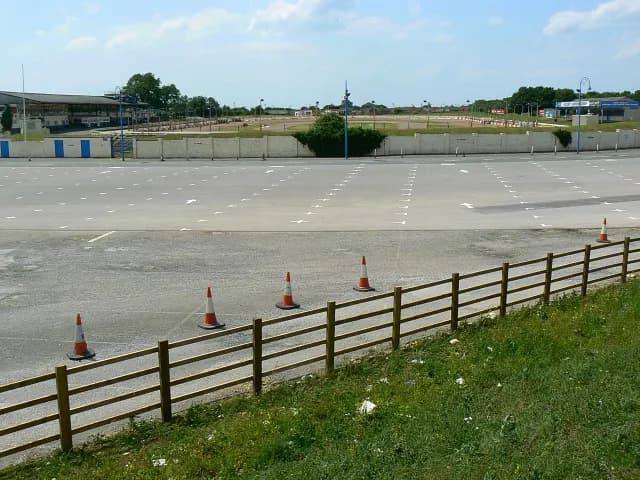
The Abbey Stadium occupied a site on Lady Lane in Blunsdon, named after the Blunsdon Abbey estate whose Victorian main house was destroyed by fire in 1904. The venue opened on the same day as the Robins' first meeting and would serve as their home for the entirety of the club's existence. The stadium capacity was approximately 2,000, and the track underwent significant changes over the years; by 2019, it had been shortened from its original 363–463 metres to 315 metres. Greyhound racing was introduced on 1 November 1952, initially as an independent operation before coming under National Greyhound Racing Club regulation in 1968. The stadium closed on 27 December 2025 following its final greyhound racing event.
The Railway Connection
Swindon's identity has been inextricably linked to the railway since the Great Western Railway Works opened in 1843. At its peak, the works employed over 14,000 people and occupied 320 acres; the A Shop locomotive fabrication workshop alone covered 11.25 acres, making it one of the largest covered areas in the world. When the works closed in 1986, the town lost not only its primary employer but also a central pillar of community identity. The Swindon Robins emerged as a new source of local pride, filling some of the void left by the railway works' sporting and social clubs. Many of the early speedway supporters were drawn from the ranks of railway families, bringing the same fierce loyalty that had sustained the works' football and rugby teams.
Early Success and Championship Glory
The Robins enjoyed almost immediate success. In 1956, they captured the Division Two title, then followed it with the Division Two Knockout Cup and the league championship in 1957. This back-to-back achievement established Swindon as a force in British speedway. The club's first golden era culminated in 1967 when the Robins won the British League championship and the Midland Cup, achievements built around pivotal riders Bob Kilby and Mike Broadbank. The team also secured consecutive Midland Cup victories in 1967 and 1968.
The Barry Briggs Era
A significant turning point came in 1964 with the signing of Barry Briggs, a New Zealand rider who had already established himself as a world championship contender. Briggs rewarded the investment by securing his third world title that same year. He topped the league averages in 1967 with a remarkable 11.05 points per meeting, cementing his status as one of the sport's all-time greats and providing Swindon with genuine star power.
Famous Riders Through the Decades
The Robins have attracted a procession of celebrated riders over their history. Martin Ashby represented Swindon for an extraordinary 16 seasons from 1961 to 1979, accumulating 5,476.5 points. Australian Phil Crump signed in 1979 and scored 4,254 points, serving as the club's leading rider from 1979 to 1986. Leigh Adams, widely regarded as one of the world's finest riders for more than a decade, had three spells with Swindon; the club paid £20,000 to Poole Pirates in 1990 to secure his transfer. Jimmy Nilsen was the team number one rider during the 1980s and returned in 1996. More recently, Jason Doyle was instrumental in the 2017 championship victory, topping the UK averages that season.
The Long Wait and the Resurgence
Following the 1967 triumph, Swindon endured a 45-year championship drought. The club experienced relegation in 1992, spending two seasons in Division Two before rebuilding. The early 2000s brought renewed hope with Elite League Pairs Championship victories in 2004 and 2005, plus four consecutive play-off appearances from 2006 to 2009. The 2012 season finally ended the long wait when the Robins defeated Poole Pirates 95–89 on aggregate to claim the Elite League title. Alun Rossiter, a former rider turned team manager, guided the squad to glory. The success was not a fleeting moment; Swindon added the SGB Premiership play-off final title in 2017 and secured both the league championship and the Knockout Cup in 2019, completing a remarkable three titles in six years.
The Final Meeting and Uncertain Future
The 2019 double would prove to be the Robins' final act. The COVID-19 pandemic forced the cancellation of the entire 2020 SGB Premiership season. In January 2021, the club confirmed its withdrawal from the 2021 season, citing stadium uncertainty and economic pressures. The last speedway event at the Abbey Stadium took place on 17 October 2019. The stadium continued to host greyhound racing until its closure on 27 December 2025. A planning application to demolish the stadium and replace it with housing was refused by Swindon Borough Council in March 2026. Alun Rossiter has since lobbied to save the Abbey Stadium and bring speedway back to Swindon, whilst Swindon Motorsports Ltd has proposed a new 5,000-capacity motorsports hub near Royal Wootton Bassett. The "Swindon Needs Speedway" campaign group launched in September 2024 with a petition to retain speedway in the town. As of March 2026, the future of the Robins remains uncertain.